

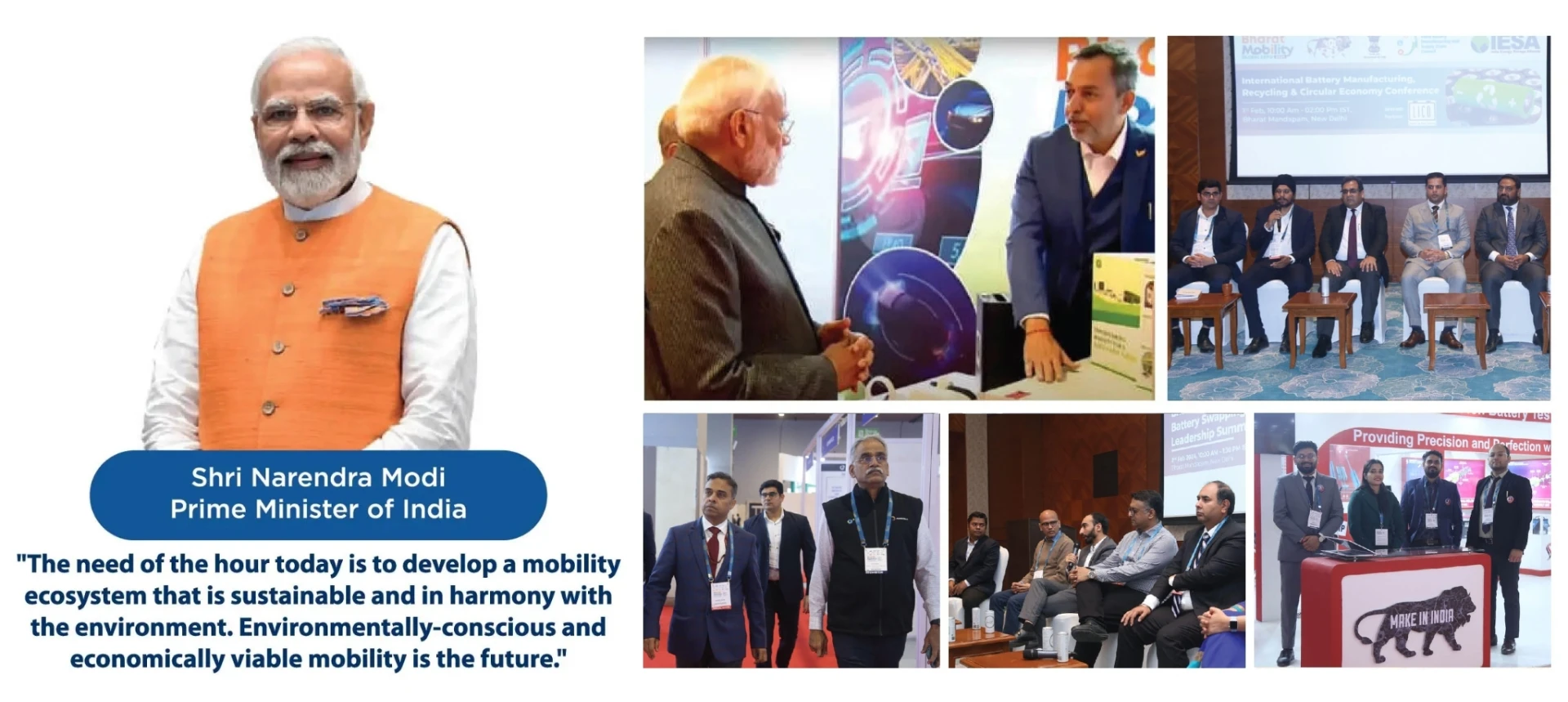
As India accelerates toward its goal of becoming a global manufacturing powerhouse, the Bharat Mobility Global Expo 2027 stands as the definitive intersection of policy, innovation, and industrial scale. Hosted by the India Energy Storage Alliance (IESA), the Battery & EV Charging Expo is curated to be the epicenter of the clean mobility value chain.
With India overtaking major global markets to become the third largest automotive hub globally, focus has shifted from adoption to indigenization. By 2027, the landscape will be defined by the successful rollout of ACC PLI schemes, expansion of 800V architectures, and the maturation of the circular economy for the EV ecosystem. This expo provides the singular platform where these milestones converge.
In 2025, the Bharat Mobility Expo set a new benchmark with nearly one million visitors and over 1,500 exhibitors. For 2027, IESA is expanding this footprint to address the specific technical and commercial needs of the high growth energy storage and EV Charging sectors.
• Market Access: Engage directly with Tier 1 OEMs, government policymakers, and international trade delegations
• Technology : Showcase the latest in EV cell chemistries, as well as high capacity Charging Systems and Bidirectional (V2G) charging
• Policy & Networking: Participate in focussed conversations and Curtain Raiser sessions that bridge the gap between mandates and execution.
• Sustainable Focus: Dedicated zone for Battery Recycling and Second Life applications, reflecting shift toward circular and resilient supply chain.
IESA Battery and EV Charging Pavilion:
Under the umbrella of the Bharat Battery Show, IESA will host specialized pavilions for:
1. Cell Manufacturing & Materials: Focusing on the cathode, anode, and electrolyte supply chains.
2. Energy Storage:
3. Infrastructure & Grid Resilience: Showcasing fast-charging hubs, battery swapping, and grid integration.
4. Future Mobility Tech: Exploring Sustainable Fuels, Green hydrogen, and long-duration storage synergy.
5. Circularity : Focus on circularity for the EV ecosystem